BlueSkyCycling.com is the only place for your online bike parts buying experience. Here at BlueSkyCycling we carry the best mountain and road bike parts, accessories, clothing and nutritional items to keep you and your bike on the go. If you're concerned about high prices, don't be. At Blue Sky Cycling we have the lowest prices on bike parts, accessories and clothing guaranteed. Nobody beats our 120-day price match policy, nobody.
Cross-Country Mountain Bikes vs Trail Mountain Bikes
Differences between Cross-Country Mountain Bikes and Trail Mountain Bikes
A lot of people usually find it hard to identify the
correct mountain bike for them. Although choosing a bike may all depend on your
riding style, the terrain you will be riding on and who you will be riding
with, getting the right bike that fits your style is tricky. The trail mountain
bike and the cross-country mounting bike are quite identical and can easily be
confused at first glance. There are
several areas where you can find a significant difference between the two
bikes. Physical features of the bikes such as the length of the stems, the
width of the handlebars, the braking system, the suspension travel, and tires
are normally taken into consideration when identifying these types of mountain
bikes. You can find all your mountain bike parts and accessories below on the Blue Sky Cycling website.
The Handlebars - The cross country mountain
bike has a narrow handlebar. Since the
cross country bikes are built for maximum speed and agility, a narrow handlebar
enables the rider to get a feel of what the front wheel is doing. It is also
quick to steer around corners. A wide handlebar on trail bikes gives the rider
enough leverage to maneuver technical terrain. It helps the rider not to be
thrown around when going through rock gardens.
The Stem length -The cross country mountain
bike features a longer stem length of approximately 90mm - 100mm. The long stem
positions the rider in a posture that pushes the rider's body further forward
for enhanced grip on flat terrain, and maximum acceleration. On the other hand,
the trail bike has a shorter stem length of approximately 40mm -80mm. A short
stem keeps the rider's posture laid more backward for better stability during
steep downhill riding.
The Suspension Travel - A cross country
mountain bike has a shorter travel of suspension than the trail bike. A shorter
travel of suspension enhances a quick uphill sprint. For real fast
cross-country mountain bikes, the comfort of the rear suspension has been
eliminated to boost pedaling efficiency.
A longer suspension travel provides comfort and easy crawling
capabilities over obstacles.
The Head
angle - Due to a longer suspension travel in the front, trail
bikes also have a wider head angle which is good for down hill riding. It positions
the front wheel far much ahead of the rider making the bike stable even on
steep downhill maneuvers. On the other hand, the short suspension travel on a
cross-country bike forces it to have a narrower head angle which makes a cross
country bike more twitchy when riding on steep down hills.
The Brake Rotor - A trail bike has a
relatively large brake rotor compared to the cross country bike. A large brake
rotor of about 140mm - 160mm is key to a more powerful braking system, which is
essential when down hilling at a fast speed. Due to its wide surface area, a
large brake rotor is less likely to overheat and cause brake failure than smaller
brake rotors. Since cross-country mountain bikes are quite twitchy on the
downhill ride, a powerful braking system will only make things worse.
Therefore, its brake rotor is much smaller and less powerful.
Tires - A Cross-country bike has
smoother tires to enhance faster rolling for maximum speed while the trail
bikes feature wide and heavily threaded tires for better grip and stability on
unstable grounds.
Apart from the
physical features of theses mountain bikes, they can also be identified by
their capabilities, or what they can do better than the other. For example,
cross country mountain bikes are slower on the descent and faster on climbs and
flat surfaces. Trail mountain bikes are slower on climbs and fast and fun to
ride on down hills. Considering the overall speed, the cross country bikes are
far much faster than trails bikes. While the trail bikes can take a corner
quite aggressively with more grip, the cross country is able to maneuver
sharper corners with more agility. The trail bikes do break faster and more
precisely. The cross country bike is lighter and quicker in acceleration and
steering while the trail bikes are heavier and optimized for descends. Today's mountain bikes have become extremely specialized
in terms of their intended use. On one extreme you will find the cross-country
racing mountain bikes. On the other extreme, you will find the downhill racing
mountain bikes. The trail mountain bike sits in between the two types of bikes
and tries to serve the purposes of both ends but to a limited extent. How to set up your mountain bike is important. Click to check out how to set up a mountain bike. Or you can watch a quick video below that will show you the steps...
You can tell the
difference between them by having a closer look at the handlebars, the stem
length, the suspension travel, the brake rotor, the tires, and the head angle.
The handle bars vary in length with the shorter ones for cross country bikes
and the longer ones for trail bikes. Long stem length creates the appropriate
body posture for cross country bikers while short stem lengths pull the cyclist
backward for safer down hill riding on the trail. A long suspension travel is
fit for trail bikes while cross country bikes feature a shorter travel on the
suspension. Trail bikes have a large brake rotor for a more powerful breaking
experience while cross-country bikes have smaller brake rotors. The tires on a
cross country mountain bike are thinner relatively smoother for maximum speed
compared to trail mountain bikes which have rougher and wider tires for better
grip on technical terrains. With all these features in mind, you can easily
tell the two types of mountain bikes apart. If you have any questions please feel free to leave us a comment. Thank you!
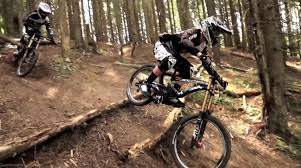
There are two similar genres of mountain biking that are always confused. By the way, Blue Sky Cycling offers online mountain bike sales for all types of mountain biking including downhill racing. Check it out after you read this article! There are all types of downhill mountain biking parts if you decide to enjoy downhill biking. They are quite tricky to tell apart. The Freeride Mountain biking and the downhill mountain biking. Both of them are done on steep and in very rough terrains. These terrains feature steep drops, jumps, fire roads, rock gardens and other naturally occurring obstacles such as roots. Both freeride and downhill mountain bikers use similar types of mountain bikes. A downhill mountain bike can easily and comfortably be used for freeriding and vice versa. In this particular case, we are going to take a deeper look into downhill mountain biking.
Some Downhill Mountain Biking Eye Candy Video....
Downhill Mountain Bikes
Due to the very unique, rough, and tough to ride terrains involved in downhill mountain biking, this genre of mountain biking require very special types of mountain bikes. The bikes must first of all ensure the safety of the rider. One biggest achievement in down hilling is for the rider and the bike to remain in one piece at the end of the race. They should also include features that makes it easy to drop, dirt jump, and roll over obstacles easily. Unlike other mountain bikes, the downhill mountain bikes are heavy and strong. Their front suspension should have at least 8 inches of travel to be able to cope with all the rough and tough trails. Such kind of a suspension glides smoothly over roots and rocks.
Downhill Mountain Biking Trails and Venues
Proper down hilling trails should be built on naturally occurring hills and mountains. These trails need to be as natural as possible. However, manmade structures are usually added sparingly to achieve desired effects on the trails. The natural trails are usually modified too, especially when avoiding very dangerous lines. When choosing and building downhill mountain bike trails, experienced riders and judges must always be involved since they always know better.
It is always difficult if not impossible to ride or walk up the hill to the starting point. Moreover, downhill mountain bikes are never designed with uphill riding in mind. So how do the riders and their bikes get up the mountain to the starting point? Thanks to the electronic winch and motor technology. The riders and their bikes can either ride on trams, chair lifts or gondolas to the top of the mountain. Alternatively, shuttling which uses motorized vehicles can be used. Other down hilling venues are designed in such a way that a road can wind up to the top of the hill. When creating a downhill trail is not an easy task. The designers have to consider critical factors such as safety, the spectators view, difficulty, variety, fun, just mentioning a few.
The Trail Placement
Considering that down hilling trails are one way trails for single-use, and are technically designed to suit no other sport or activity apart from Downhill Mountain biking, No other users should share or interfere with the trails. The trails should be placed is such a way as to avoid any conflict with any other activity. To separate and avoid conflict between downhill rides of different abilities and skills, at least two trails should be created.
The Ideal Downhill Mountain Biking Trail
An ideal downhill trail should include features such as:
Vertical Drops - A variety of vertical drops or approximately 1000 feet and above; the more the drops, the better. These drops can go to a height of more than 2000 feet.
Jumps and Drop Offs - These are normally the funnest part of the ride. They should be clearly visible and marked to enable the rider to make a split second decision on whether to ride them or bypass them. Clearly marked alternative bypasses should also be included. It is over these jumps, drops and drop-offs that riders like to show off their skills and tricks such as the 360s, back and forward flips, no handlers and many more.
Open and Flowing Sections- These allows the rider to make a split second choice from the available variety of lines. This section should be wide and rough, the perfect section to test the rider's skills and abilities when it comes to stability in technical high speed riding. Since downhill bikes are not good at pedaling, the open and flowing section should come after a very steep downhill ride.
Tight and Technical Sections- This is meant to be a slower section challenging the rider's abilities to make quick turns, overcome obstacles such as logs, and glide through difficult terrains.
The Downhill Mountain Bike Competition
What makes a huge clear cut distinction between freeride mountain biking and downhill mountain biking is the competition. Unlike freeride mountain bike competition whereby the winner is determined by how much tricks in terms of difficulty and creativity you can show off, the downhill mountain bike competition is focused on the speed. The riders are provided with a particular trail and they have to work out how to get to the finish line within the shortest time possible. It is up to the rider to decide and take a line that will give him/her the most advantage depending on his or her riding styles and abilities. For example, while a jump may be the shortest way to use, but the alternative line beside it can be ridden at a very high speed. Therefore the rider will make the decision within the split of a second depending on his/her approaching momentum, abilities, and instincts. The riders are normally given one or two attempts to ride from the start to the finish and the best time between the two is recorded as the final score.
To sum up, downhill mountain biking is reserved for expert mountain bike riders. It requires a lot of skill and time on a mountain bike. The speed is much faster therefore you have to make decisions quicker. Always make sure you have the correct mountain biking gear to ensure you will not hurt your bike or more importantly your self. If you spend a lot of time on downhill trails sign up for a competition and give it hell! We hope you enjoyed this article. If you have any questions regarding down hill mountain bike riding please feel free to leave a comment below.